




ie
IE
Ireland
en-IE
ie_inst_classes
inst
Institutional
en
en
For use by professional clients and/or equivalent investor types in your jurisdiction (not to be used with or passed on to retail clients).
A modern glass office building with large reflective windows, surrounded by tall green trees in the foreground.

Insights

Unpicking the US securitised credit universe – asset types and characteristics

Ryan Osborn
Ryan Osborn
Co-Head of Structured Assets, Senior Portfolio Manager
LDI Analyst
Sangaran Gobalakrishnan
LDI Analyst
Luke Copley
Client Portfolio Manager, Fixed Income
We began our mini-series of short articles about securitised credit with an overview piece on what asset-backed securities are and how the mechanism broadly works.1 In this second piece we will drill down into the different types of securities and their individual characteristics.

The $14 trillion US securitised market comprises the following major subsectors:

  1. Residential mortgage-backed securities (RMBS)
  2. Commercial mortgage-backed securities (CMBS)
  3. Consumer asset-backed securities (ABS)
  4. Collateralised loan obligations (CLOs)

Below we dive deeper into each asset type and look at the risks involved with each.

RMBS

These securities are backed by pools of single-family residential mortgages.  There are two main types: agency and non-agency.

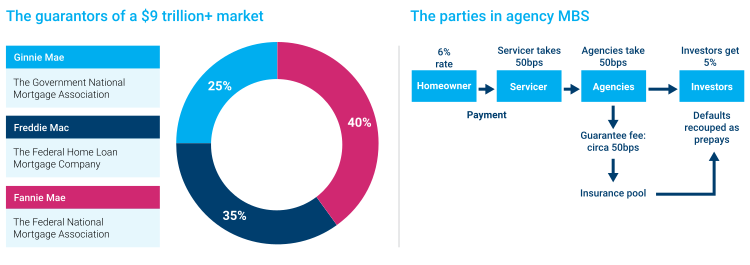
Agency RMBS: Accounting for around 60% of the total US securitised market, these mortgage-backed securities (MBS) are guaranteed by government-sponsored enterprises (GSEs) such as Fannie Mae or Freddie Mac (Figure 1). For a mortgage to be eligible for GSE underwriting it must conform to strict criteria incorporating affordability checks, income verification and loan terms (such as size and property type).

The GSE guarantee ensures that investors receive payments even if underlying borrowers default.  This dynamic gives Agency RMBS high credit quality characteristics. Given the size of the agency market, it is the most widely traded and liquid segment of securitised credit. 

Agency RMBS are predominantly based on underlying mortgages with 30-year terms. However, the average life of the MBS bond is usually much shorter. Unlike traditional “bullet” bonds, where the principal is repaid at maturity, mortgages are amortising – ie, the principal is gradually paid down each month as borrowers repay their loans. In addition, residential borrowers can repay their mortgage at any time. This results in prepayment risk, where cashflows are brought forward, shortening the average life of the bond further.

MBS exist with different vintages, depending on the prevailing mortgage rate at the point of issuance.  A recent deal will be labelled “current coupon”, but more seasoned MBS may have coupons based on mortgage rates above or below current rates. The difference in these rates will determine the extent of expected prepayment risk, and in turn the yield on offer to MBS investors.

Figure 1: The RMBS setup

Non-agency RMBS: These offer different risk-return characteristics to agency structures, and a greater diversity of asset types. They account for around 5% of the US securitised market. Non-agency bonds are typically originated by banks rather than GSEs, and while they are still backed by pools of residential mortgages, they can include loans beyond traditional single-family primary-residences.

These securities often provide yield more than agency bonds. This is due to the lack of GSE guarantee and, in some instances, greater complexity in the asset pool. However, this doesn’t necessarily mean that loan quality is poor. Many prime loans may not conform to agency criteria for numerous reasons.

For example, three common types of non-agency RMBS are:

  • Jumbos: These securities are backed by mortgages that exceed the conforming loan limits set by the GSEs (typically around $850,000 in most areas). Such loans may finance homes owned by high-income borrowers in prime real estate locations.


  • Non-qualified mortgages: These are securities backed by loans that don’t meet Qualified Mortgage regulatory criteria (ie, they don’t conform to agency standards) but are still considered creditworthy. Common examples include loans to self-employed borrowers who cannot provide traditional income documentation, foreign nationals, or borrowers with unique financial situations.


  • Credit risk transfer: These are securities where GSEs transfer a portion of their credit risk to the investor while retaining first-loss exposure. The underlying mortgages meet GSE underwriting standards, but investors assume some credit risk if borrowers default.


There are other non-agency sectors such as non-performing loans or subprime, but these carry higher risk profiles.

For non-agency bonds, in addition to loan-level collateral analysis, it is relevant to assess originator risks – for example, governance practices, reputation and track record. There is also a servicer involved in the administration of the loans through their lifespan, whose credentials can also be assessed.

CMBS

In total, CMBS accounts for around 20% of the US securitised market. As with RMBS, CMBS has both agency and non-agency models. The main difference is that CMBS provides exposure to the commercial real estate sector in which the underlying assets include offices, retail units, hotels, multi-family buildings and industrial sites etc.

What are known as Conduit CMBS deals are typically based on a pool of 50-75 diverse loans, reducing concentration risk across several commercial asset types. There are also single asset/single borrower (SASB) deals where the collateral is based on a single building – typically a trophy property such as a city skyscraper. The transparency of the SASB setup, in terms of collateral valuation and visibility on the underlying tenant(s) supporting the lease cashflows, can offer good reassurance on the credit quality of the CMBS.

Consumer ABS

These are securities backed by consumer loans and account for around 6% of the US securitised market. Collateral typically includes autos loans, credit card receivables and student loans, each with distinct profiles:

  • Autos: This is the largest component of the Consumer ABS market and spans a diverse mix of geographies, vehicle types, new versus used vehicles, and lease versus loan structures. Deals can be static pools or revolving facilities, allowing investors to target specific asset segments based on risk appetite. For example, some auto ABS may be focused on electric vehicles only.  


  • Credit cards: These securities are backed by thousands of receivables from consumer credit card spending transactions. These securities will typically have a revolving period (where the issuer will reinvest repaid principal into new receivables), which helps maintain the pool size until the amortisation period commences.   


  • Student loans: These feature longer repayment periods with both fixed- and floating-rate options available. Student loan ABS can be backed by either public (government-guaranteed) or private student loans.


Consumer ABS securities provide diversification within fixed income portfolios as they are driven by the consumer spending cycle rather than the corporate or housing cycles. 

CLOs

CLOs are securities backed by pools of corporate loans typically made to mid-market and smaller companies. A CLO manager will select loans to package into the CLO pool and manage the loan composition over the CLO lifespan. For example, this can involve refreshing the pool within defined investment guidelines to keep the sector and credit rating composition balanced. 

The loans are predominantly floating rates in nature – coupons linked to prevailing cash rates, plus a spread premium – and therefore do not exhibit interest rate sensitivity in their performance behaviour. 

Similar to ABS and all non-agency MBS, CLOs are tranched to create a waterfall priority for cashflow distribution to investors (Figure 2). This credit enhancement feature helps offset the absence of any government guarantee in these sectors.

Figure 2: The CLO waterfall
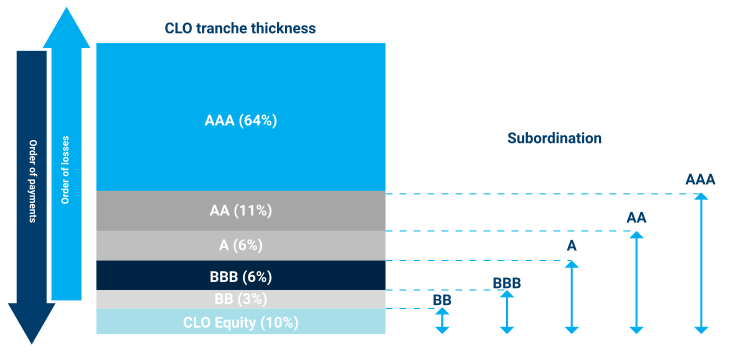
1 Tranche thickness is the par value of the tranche divided by the par value of the underlying CLO asset portfolio. CLO liability percentages are typical of post-2010 vintage structures.

Key risks by subsector

RMBS

  • Prepayment risk: If interest rates fall, borrowers are likely to refinance at more attractive mortgage rates. This early return of principal to MBS investors results in a loss of future cashflow income, and a requirement to find other reinvestment opportunities.   
 
  • Credit risk: Low for agency bonds given the GSE underwriting. Potentially greater credit risk for non-agency bonds depending on collateral composition, but this is largely offset by credit enhancement through the tranching mechanism. Originator and servicer risk assessments are useful.

CMBS

  • Prepayment risk: Often mitigated by prepayment penalties.


  • Extension risk: Due to the lack of amortisation, commercial mortgages often face a “balloon payment” of principal at their expected maturity date (ie, the end of their fixed-term period, often after five to 10 years). This is usually achieved by a refinancing operation, but if refinancing conditions are unfavourable for the borrower, and the balloon payment cannot be met, the commercial mortgage may be extended to its final legal maturity date (often 30-years). 


  • Credit risk: Sensitivity to the commercial real estate cycle.

Consumer ABS

  • Credit risk: Sensitivity to the consumer spending cycle.

CLOs

  • Credit risk: Sensitivity to the corporate business cycle. The underlying loans are typically made to mid-market companies that may not have the scale to directly access capital markets for bond financing. These companies will often have the equivalent of sub-investment grade credit ratings. Therefore, the credit enhancement/tranching structure within the CLO is a key mechanism for increasing investor protection.


  • Manager risk: Similar to originator risk analysis for MBS deals, the CLO manager’s role within loan securitisations is important to consider. Managers with strong governance practices typically deliver more stable CLOs.

The bottom line

The US securitised credit market comprises a diverse mix of asset types, offering exposure to a variety of economic sensitivities. 

This investment universe, which covers the full range of securitised sectors, allows us to access a true spectrum of risk/return opportunities – and gives us the flexibility to dial portfolio risk utilisation depending on how favourable we think the return outlook may be.


CT US Asset-Backed Securities Fund

A diversifier for investment grade credit portfolios. Targeting liquidity, stability and attractive risk-adjusted returns through active management.

Key topics

Subscribe to insights

Get the most out of your email by tailoring the types of insights and information you would like to receive from us.

Latest articles

In the second piece in an educational series on US ABS we drill down into the different types of securities and their individual characteristics
The EUR swap curve is telling a fascinating story amid the Iran conflict.
Today we will look at Iran and the impact on central banks.
Key topics
Related topics

1Columbia Threadneedle Investments, US asset-backed securities: the basics, 30 October 2025

Important information:

For use by professional clients and/or equivalent investor types in your jurisdiction (not to be used with or passed on to retail clients). For marketing purposes.


This document is intended for informational purposes only and should not be considered representative of any particular investment. This should not be considered an offer or solicitation to buy or sell any securities or other financial instruments, or to provide investment advice or services. Investing involves risk including the risk of loss of principal. Your capital is at risk. Market risk may affect a single issuer, sector of the economy, industry or the market as a whole. The value of investments is not guaranteed, and therefore an investor may not get back the amount invested. International investing involves certain risks and volatility due to potential political, economic or currency fluctuations and different financial and accounting standards. The securities included herein are for illustrative purposes only, subject to change and should not be construed as a recommendation to buy or sell. Securities discussed may or may not prove profitable. The views expressed are as of the date given, may change as market or other conditions change and may differ from views expressed by other Columbia Threadneedle Investments (Columbia Threadneedle) associates or affiliates. Actual investments or investment decisions made by Columbia Threadneedle and its affiliates, whether for its own account or on behalf of clients, may not necessarily reflect the views expressed. This information is not intended to provide investment advice and does not take into consideration individual investor circumstances. Investment decisions should always be made based on an investor’s specific financial needs, objectives, goals, time horizon and risk tolerance. Asset classes described may not be suitable for all investors. Past performance does not guarantee future results, and no forecast should be considered a guarantee either. Information and opinions provided by third parties have been obtained from sources believed to be reliable, but accuracy and completeness cannot be guaranteed. This document and its contents have not been reviewed by any regulatory authority.


In Australia: Issued by Threadneedle Investments Singapore (Pte.) Limited [“TIS”], ARBN 600 027 414. TIS is exempt from the requirement to hold an Australian financial services licence under the Corporations Act 2001 (Cth) and relies on Class Order 03/1102 in respect of the financial services it provides to wholesale clients in Australia. This document should only be distributed in Australia to “wholesale clients” as defined in Section 761G of the Corporations Act. TIS is regulated in Singapore (Registration number: 201101559W) by the Monetary Authority of Singapore under the Securities and Futures Act (Chapter 289), which differ from Australian laws.


In Singapore: Issued by Threadneedle Investments Singapore (Pte.) Limited, 3 Killiney Road, #07-07, Winsland House 1, Singapore 239519, which is regulated in Singapore by the Monetary Authority of Singapore under the Securities and Futures Act (Chapter 289). Registration number: 201101559W. This advertisement has not been reviewed by the Monetary Authority of Singapore.


In Hong Kong: Issued by Threadneedle Portfolio Services Hong Kong Limited 天利投資管理香港有限公司. Unit 3004, Two Exchange Square, 8 Connaught Place, Hong Kong, which is licensed by the Securities and Futures Commission (“SFC”) to conduct Type 1 regulated activities (CE:AQA779). Registered in Hong Kong under the Companies Ordinance (Chapter 622), No. 1173058.


In Japan: Issued by Columbia Threadneedle Investments Japan Co., Ltd. Financial Instruments Business Operator, The Director-General of Kanto Local Finance Bureau (FIBO) No.3281, and a member of Japan Investment Advisers Association and Type II Financial Instruments Firms Association.


In the UK: Issued by Threadneedle Asset Management Limited, No. 573204 and/or Columbia Threadneedle Management Limited, No. 517895, both registered in England and Wales and authorised and regulated in the UK by the Financial Conduct Authority.


In the EEA: Issued by Threadneedle Management Luxembourg S.A., registered with the Registre de Commerce et des Sociétés (Luxembourg), No. B 110242 and/or Columbia Threadneedle Netherlands B.V., regulated by the Dutch Authority for the Financial Markets (AFM), registered No. 08068841.


In Switzerland: Issued by Threadneedle Portfolio Services AG, Registered address: Claridenstrasse 41, 8002 Zurich, Switzerland.


In the Middle East: This document is distributed by Columbia Threadneedle Investments (ME) Limited, which is regulated by the Dubai Financial Services Authority (DFSA). For Distributors: This document is intended to provide distributors with information about Group products and services and is not for further distribution. For Institutional Clients: The information in this document is not intended as financial advice and is only intended for persons with appropriate investment knowledge and who meet the regulatory criteria to be classified as a Professional Client or Market Counterparties and no other Person should act upon it.


This document may be made available to you by an affiliated company which is part of the Columbia Threadneedle Investments group of companies: Columbia Threadneedle Management Limited in the UK; Columbia Threadneedle Netherlands B.V., regulated by the Dutch Authority for the Financial Markets (AFM), registered No. 08068841.


Columbia Threadneedle Investments is the global brand name of the Columbia and Threadneedle group of companies. © 2026 Columbia Threadneedle. All rights reserved.

Related insights

24 March 2026

In Credit Weekly Snapshot – The curve that got away

The EUR swap curve is telling a fascinating story amid the Iran conflict.
17 March 2026

In Credit Weekly Snapshot – I won’t back down: stalemate in Strait of Hormuz

There seems to be no easy way out of the Iran war, as the ongoing closure of the crucial seaway continues to impact prices and economies around the world. Read on for a breakdown of fixed income news across sectors and regions.
10 March 2026

In Credit Weekly Snapshot – Smoke on the water

The market continues to trade on the potential macro consequences of events in the Middle East, with the threat of Iranian attacks effectively closing the Strait of Hormuz, leading to a sharp spike in oil prices.
24 March 2026

In Credit Weekly Snapshot – The curve that got away

The EUR swap curve is telling a fascinating story amid the Iran conflict.
23 March 2026

Anthony Willis

Senior Economist, Multi-Asset Solutions team

Market Perspectives: The fog of war and monetary policy

Today we will look at Iran and the impact on central banks.
20 March 2026

Arthur Stroij

LDI Client Portfolio Manager

Jan Willemsen

LDI Client Portfolio Manager

20 years of Euro LDI funds: A proven foundation now widely supporting European pension schemes

Liability-driven investment has transformed from a Dutch regulatory response into a mature, pan European framework for pension risk management.

Important information:

For use by professional clients and/or equivalent investor types in your jurisdiction (not to be used with or passed on to retail clients). For marketing purposes.


This document is intended for informational purposes only and should not be considered representative of any particular investment. This should not be considered an offer or solicitation to buy or sell any securities or other financial instruments, or to provide investment advice or services. Investing involves risk including the risk of loss of principal. Your capital is at risk. Market risk may affect a single issuer, sector of the economy, industry or the market as a whole. The value of investments is not guaranteed, and therefore an investor may not get back the amount invested. International investing involves certain risks and volatility due to potential political, economic or currency fluctuations and different financial and accounting standards. The securities included herein are for illustrative purposes only, subject to change and should not be construed as a recommendation to buy or sell. Securities discussed may or may not prove profitable. The views expressed are as of the date given, may change as market or other conditions change and may differ from views expressed by other Columbia Threadneedle Investments (Columbia Threadneedle) associates or affiliates. Actual investments or investment decisions made by Columbia Threadneedle and its affiliates, whether for its own account or on behalf of clients, may not necessarily reflect the views expressed. This information is not intended to provide investment advice and does not take into consideration individual investor circumstances. Investment decisions should always be made based on an investor’s specific financial needs, objectives, goals, time horizon and risk tolerance. Asset classes described may not be suitable for all investors. Past performance does not guarantee future results, and no forecast should be considered a guarantee either. Information and opinions provided by third parties have been obtained from sources believed to be reliable, but accuracy and completeness cannot be guaranteed. This document and its contents have not been reviewed by any regulatory authority.


In Australia: Issued by Threadneedle Investments Singapore (Pte.) Limited [“TIS”], ARBN 600 027 414. TIS is exempt from the requirement to hold an Australian financial services licence under the Corporations Act 2001 (Cth) and relies on Class Order 03/1102 in respect of the financial services it provides to wholesale clients in Australia. This document should only be distributed in Australia to “wholesale clients” as defined in Section 761G of the Corporations Act. TIS is regulated in Singapore (Registration number: 201101559W) by the Monetary Authority of Singapore under the Securities and Futures Act (Chapter 289), which differ from Australian laws.


In Singapore: Issued by Threadneedle Investments Singapore (Pte.) Limited, 3 Killiney Road, #07-07, Winsland House 1, Singapore 239519, which is regulated in Singapore by the Monetary Authority of Singapore under the Securities and Futures Act (Chapter 289). Registration number: 201101559W. This advertisement has not been reviewed by the Monetary Authority of Singapore.


In Hong Kong: Issued by Threadneedle Portfolio Services Hong Kong Limited 天利投資管理香港有限公司. Unit 3004, Two Exchange Square, 8 Connaught Place, Hong Kong, which is licensed by the Securities and Futures Commission (“SFC”) to conduct Type 1 regulated activities (CE:AQA779). Registered in Hong Kong under the Companies Ordinance (Chapter 622), No. 1173058.


In Japan: Issued by Columbia Threadneedle Investments Japan Co., Ltd. Financial Instruments Business Operator, The Director-General of Kanto Local Finance Bureau (FIBO) No.3281, and a member of Japan Investment Advisers Association and Type II Financial Instruments Firms Association.


In the UK: Issued by Threadneedle Asset Management Limited, No. 573204 and/or Columbia Threadneedle Management Limited, No. 517895, both registered in England and Wales and authorised and regulated in the UK by the Financial Conduct Authority.


In the EEA: Issued by Threadneedle Management Luxembourg S.A., registered with the Registre de Commerce et des Sociétés (Luxembourg), No. B 110242 and/or Columbia Threadneedle Netherlands B.V., regulated by the Dutch Authority for the Financial Markets (AFM), registered No. 08068841.


In Switzerland: Issued by Threadneedle Portfolio Services AG, Registered address: Claridenstrasse 41, 8002 Zurich, Switzerland.


In the Middle East: This document is distributed by Columbia Threadneedle Investments (ME) Limited, which is regulated by the Dubai Financial Services Authority (DFSA). For Distributors: This document is intended to provide distributors with information about Group products and services and is not for further distribution. For Institutional Clients: The information in this document is not intended as financial advice and is only intended for persons with appropriate investment knowledge and who meet the regulatory criteria to be classified as a Professional Client or Market Counterparties and no other Person should act upon it.


This document may be made available to you by an affiliated company which is part of the Columbia Threadneedle Investments group of companies: Columbia Threadneedle Management Limited in the UK; Columbia Threadneedle Netherlands B.V., regulated by the Dutch Authority for the Financial Markets (AFM), registered No. 08068841.


Columbia Threadneedle Investments is the global brand name of the Columbia and Threadneedle group of companies. © 2026 Columbia Threadneedle. All rights reserved.

Thank you. You can now visit your preference centre to choose which insights you would like to receive by email.

To view and control which insights you receive from us by email, please visit your preference centre.

Woman listens to music through headphones
Play Video

CT Property Trust- Fund Manager Update

Sed ut perspiciatis unde omnis iste natus error sit voluptatem accusantium doloremque laudantium