





The $14 trillion US securitised market comprises the following major subsectors:
- Residential mortgage-backed securities (RMBS)
- Commercial mortgage-backed securities (CMBS)
- Consumer asset-backed securities (ABS)
- Collateralised loan obligations (CLOs)
Below we dive deeper into each asset type and look at the risks involved with each.
RMBS
These securities are backed by pools of single-family residential mortgages. There are two main types: agency and non-agency.
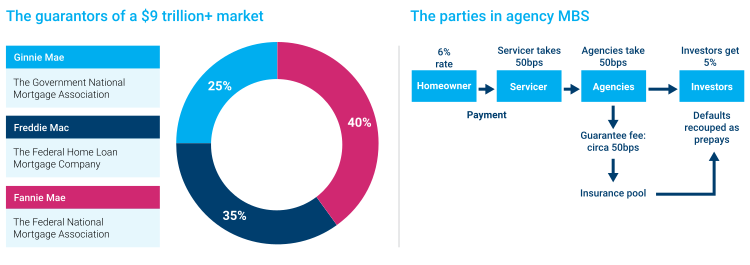
Agency RMBS: Accounting for around 60% of the total US securitised market, these mortgage-backed securities (MBS) are guaranteed by government-sponsored enterprises (GSEs) such as Fannie Mae or Freddie Mac (Figure 1). For a mortgage to be eligible for GSE underwriting it must conform to strict criteria incorporating affordability checks, income verification and loan terms (such as size and property type).
The GSE guarantee ensures that investors receive payments even if underlying borrowers default. This dynamic gives Agency RMBS high credit quality characteristics. Given the size of the agency market, it is the most widely traded and liquid segment of securitised credit.
Agency RMBS are predominantly based on underlying mortgages with 30-year terms. However, the average life of the MBS bond is usually much shorter. Unlike traditional “bullet” bonds, where the principal is repaid at maturity, mortgages are amortising – ie, the principal is gradually paid down each month as borrowers repay their loans. In addition, residential borrowers can repay their mortgage at any time. This results in prepayment risk, where cashflows are brought forward, shortening the average life of the bond further.
MBS exist with different vintages, depending on the prevailing mortgage rate at the point of issuance. A recent deal will be labelled “current coupon”, but more seasoned MBS may have coupons based on mortgage rates above or below current rates. The difference in these rates will determine the extent of expected prepayment risk, and in turn the yield on offer to MBS investors.
Figure 1: The RMBS setup
Non-agency RMBS: These offer different risk-return characteristics to agency structures, and a greater diversity of asset types. They account for around 5% of the US securitised market. Non-agency bonds are typically originated by banks rather than GSEs, and while they are still backed by pools of residential mortgages, they can include loans beyond traditional single-family primary-residences.
These securities often provide yield more than agency bonds. This is due to the lack of GSE guarantee and, in some instances, greater complexity in the asset pool. However, this doesn’t necessarily mean that loan quality is poor. Many prime loans may not conform to agency criteria for numerous reasons.
For example, three common types of non-agency RMBS are:
- Jumbos: These securities are backed by mortgages that exceed the conforming loan limits set by the GSEs (typically around $850,000 in most areas). Such loans may finance homes owned by high-income borrowers in prime real estate locations.
- Non-qualified mortgages: These are securities backed by loans that don’t meet Qualified Mortgage regulatory criteria (ie, they don’t conform to agency standards) but are still considered creditworthy. Common examples include loans to self-employed borrowers who cannot provide traditional income documentation, foreign nationals, or borrowers with unique financial situations.
- Credit risk transfer: These are securities where GSEs transfer a portion of their credit risk to the investor while retaining first-loss exposure. The underlying mortgages meet GSE underwriting standards, but investors assume some credit risk if borrowers default.
There are other non-agency sectors such as non-performing loans or subprime, but these carry higher risk profiles.
For non-agency bonds, in addition to loan-level collateral analysis, it is relevant to assess originator risks – for example, governance practices, reputation and track record. There is also a servicer involved in the administration of the loans through their lifespan, whose credentials can also be assessed.
CMBS
In total, CMBS accounts for around 20% of the US securitised market. As with RMBS, CMBS has both agency and non-agency models. The main difference is that CMBS provides exposure to the commercial real estate sector in which the underlying assets include offices, retail units, hotels, multi-family buildings and industrial sites etc.
What are known as Conduit CMBS deals are typically based on a pool of 50-75 diverse loans, reducing concentration risk across several commercial asset types. There are also single asset/single borrower (SASB) deals where the collateral is based on a single building – typically a trophy property such as a city skyscraper. The transparency of the SASB setup, in terms of collateral valuation and visibility on the underlying tenant(s) supporting the lease cashflows, can offer good reassurance on the credit quality of the CMBS.
Consumer ABS
These are securities backed by consumer loans and account for around 6% of the US securitised market. Collateral typically includes autos loans, credit card receivables and student loans, each with distinct profiles:
- Autos: This is the largest component of the Consumer ABS market and spans a diverse mix of geographies, vehicle types, new versus used vehicles, and lease versus loan structures. Deals can be static pools or revolving facilities, allowing investors to target specific asset segments based on risk appetite. For example, some auto ABS may be focused on electric vehicles only.
- Credit cards: These securities are backed by thousands of receivables from consumer credit card spending transactions. These securities will typically have a revolving period (where the issuer will reinvest repaid principal into new receivables), which helps maintain the pool size until the amortisation period commences.
- Student loans: These feature longer repayment periods with both fixed- and floating-rate options available. Student loan ABS can be backed by either public (government-guaranteed) or private student loans.
Consumer ABS securities provide diversification within fixed income portfolios as they are driven by the consumer spending cycle rather than the corporate or housing cycles.
CLOs
CLOs are securities backed by pools of corporate loans typically made to mid-market and smaller companies. A CLO manager will select loans to package into the CLO pool and manage the loan composition over the CLO lifespan. For example, this can involve refreshing the pool within defined investment guidelines to keep the sector and credit rating composition balanced.
The loans are predominantly floating rates in nature – coupons linked to prevailing cash rates, plus a spread premium – and therefore do not exhibit interest rate sensitivity in their performance behaviour.
Similar to ABS and all non-agency MBS, CLOs are tranched to create a waterfall priority for cashflow distribution to investors (Figure 2). This credit enhancement feature helps offset the absence of any government guarantee in these sectors.
Figure 2: The CLO waterfall
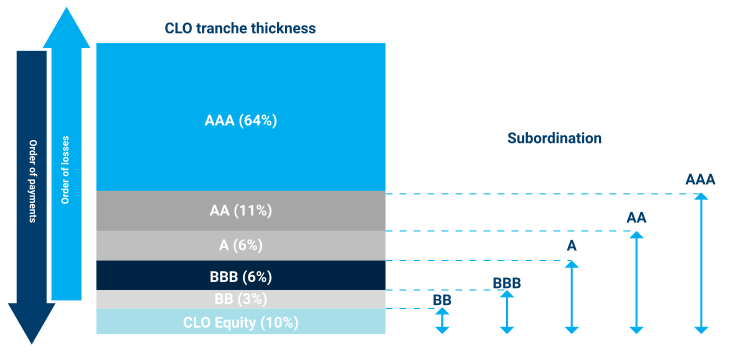
1 Tranche thickness is the par value of the tranche divided by the par value of the underlying CLO asset portfolio. CLO liability percentages are typical of post-2010 vintage structures.
Key risks by subsector
RMBS
- Prepayment risk: If interest rates fall, borrowers are likely to refinance at more attractive mortgage rates. This early return of principal to MBS investors results in a loss of future cashflow income, and a requirement to find other reinvestment opportunities.
- Credit risk: Low for agency bonds given the GSE underwriting. Potentially greater credit risk for non-agency bonds depending on collateral composition, but this is largely offset by credit enhancement through the tranching mechanism. Originator and servicer risk assessments are useful.
CMBS
- Prepayment risk: Often mitigated by prepayment penalties.
- Extension risk: Due to the lack of amortisation, commercial mortgages often face a “balloon payment” of principal at their expected maturity date (ie, the end of their fixed-term period, often after five to 10 years). This is usually achieved by a refinancing operation, but if refinancing conditions are unfavourable for the borrower, and the balloon payment cannot be met, the commercial mortgage may be extended to its final legal maturity date (often 30-years).
- Credit risk: Sensitivity to the commercial real estate cycle.
Consumer ABS
- Credit risk: Sensitivity to the consumer spending cycle.
CLOs
- Credit risk: Sensitivity to the corporate business cycle. The underlying loans are typically made to mid-market companies that may not have the scale to directly access capital markets for bond financing. These companies will often have the equivalent of sub-investment grade credit ratings. Therefore, the credit enhancement/tranching structure within the CLO is a key mechanism for increasing investor protection.
- Manager risk: Similar to originator risk analysis for MBS deals, the CLO manager’s role within loan securitisations is important to consider. Managers with strong governance practices typically deliver more stable CLOs.
The bottom line
The US securitised credit market comprises a diverse mix of asset types, offering exposure to a variety of economic sensitivities.
This investment universe, which covers the full range of securitised sectors, allows us to access a true spectrum of risk/return opportunities – and gives us the flexibility to dial portfolio risk utilisation depending on how favourable we think the return outlook may be.