


Filter insights on this page
Repo rates are expressed relative to SONIA, and the chart below displays the average repo rates that we have achieved over the past four quarters for three, six, nine and 12-month repos, shown as a spread to average SONIA levels at the time. The volatility and market uncertainty that resulted from the mini-Budget also weighed upon funding markets, particularly for shorter dated trades as can be seen from the achieved spreads below. Note that during the fourth quarter of 2022 no repos were traded with a 12m tenor so the chart reflects the previous quarter’s value.
Capabilities
Media type
Themes
The secondary impact of the mini-Budget crisis centred around collateral and the velocity of movement; rather than a lack of balance sheet for repo funding (a la March 2020). Yet, the difficulties around collateral substitutions and settlements did in many cases prompt a review by individual banks’ credit officers, resulting in a temporary reduction or hiatus in repo balance sheet provision in some cases. Once these reviews were completed balance sheet availability opened up again – some with the addition of haircuts to provide additional protection to the bank. Of course, the momentous lack of certainty in the future path of interest rates also impacted the typical repo spread to SONIA as trading a fixed rate forced the banks to take a conservative view on where yields could reach.
Indicative current pricing shows leverage via gilt TRS for a six-month tenor is very bank dependent but is on average similar to repo – this depends on the bank’s view of the repo market and whether they are impacted by Net Stable Funding Ratio regulations (NSFR). Part of the reason for higher costs for TRS is a reflection of the lack of straight-through-processing available. Columbia Threadneedle are engaging with various market providers and participants to redefine TRS and the way it is traded and confirmed.
The monetary loosening cycle continued its momentum, with the US Federal Reserve cutting their rate by 1.5% over the quarter (after a slow start to the year) and the Bank of England also completing their much-anticipated Christmas cut of 0.25%, bringing the Base Rate to 3.75%. This was in contrast to the ECB, who remained on hold throughout the fourth quarter with some market participants holding the belief that the next move will be a rate increase as early as the first half of 2026.
All data and sources Columbia Threadneedle Management Limited, as at 30 June 2024 and Valid to: 30 September 2024
Regions

Market Update
Middle East tensions remained high with no end seemingly in sight for the Iran conflict, instead contagion has spread beyond the Strait of Hormuz to other avenues of oil distribution courtesy of Houthi attacks. Pressures on oil and broader energy therefore persisted feeding into concerns about fiscal sustainability in the face of second round effects from inflation. Whilst some oil shipments are making their way through ‘dark’ channels, global supply is much diminished with the deficit growing day after day. This has prompted governments to consider other methods to stem the rise in oil prices, from releasing reserves, providing fiscal support and most recently to the US mulling a diesel export ban as average prices in the US have now risen by 70% – a concern for the upcoming mid-term elections where the cost of fuel is of sharp concern to voters. The geopolitical complications leading to potential second round effects of inflation have galvanized central banks to tighten monetary conditions, with the US Fed increasing their target rate by 0.25% to 4% in September and the ECB enacting their second hike of 0.25% also in September. All eyes are now on the Bank of England and their assumed hike at their November meeting. In prior months central banks were able to look through temporary supply side shocks but now given the length of time that the conflict has endured there is a risk that inflation becomes embedded. These rate hikes, combined with the global phenomenon of higher yields create a headache for governments as they struggle to square the circle of supporting voters facing higher costs of living versus servicing their debt at challenging levels. In the UK 30-year yields have reached the key resistance level of 6% – a level not seen since 1998, thereby limiting the scope of the new administration to increase spending on favoured policies such as defence and infrastructure nationalisation.
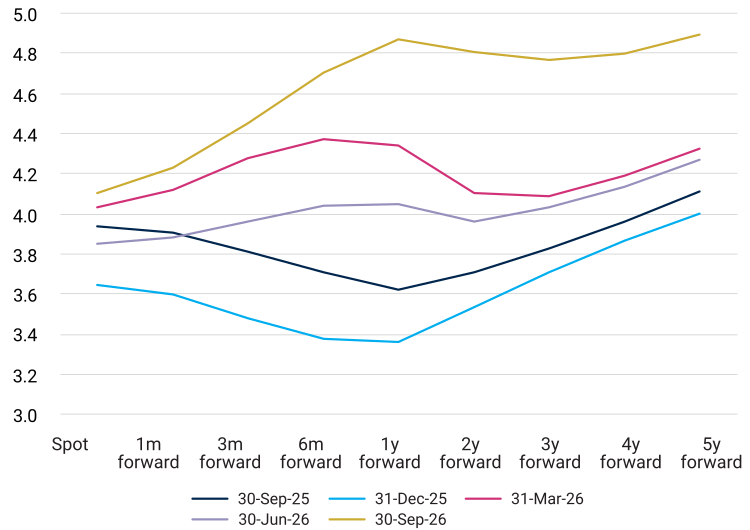
The market’s view of where long-term rates could move to in the future is encapsulated in forward rates. The chart below shows the current six-month SONIA (Sterling Overnight Index Average) swap rate (spot) and at various forward rates out to five years. As expectations of an end to the Iran conflict were dashed, the risk of entrenched inflation caused multiple rate hikes to be repriced in. One-year forward rate expectations rose by 0.82% over the quarter. However, there was significant newsflow-driven volatility throughout the quarter as investors sought comfort from seemingly positive social media posts. Note also that in contrast to prior quarters where rate hikes were expected to be temporary, there now appears to be a new normal in a higher Bank Rate for longer.
Figure 1: Six-month SONIA rate
Source: Columbia Threadneedle Investments, as at 30 September 2026
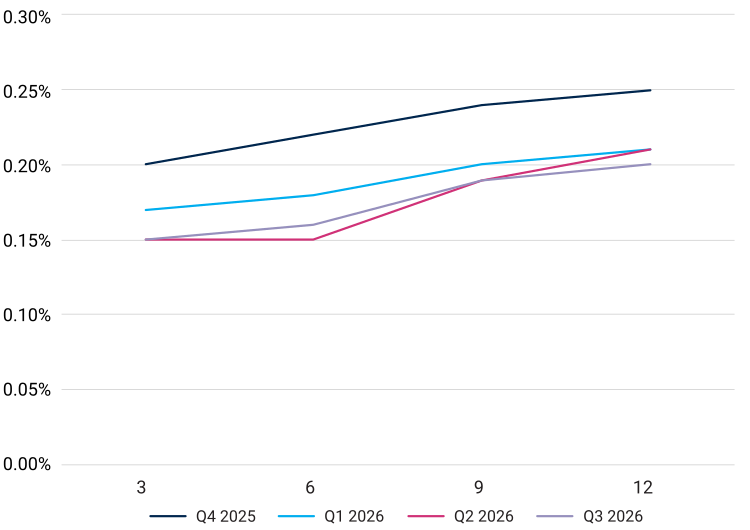
Repo rates are expressed relative to SONIA, and the chart below displays the average repo rates that we have achieved over the past four quarters for three, six, nine and 12-month repos, shown as a spread to average SONIA levels at the time. The volatility of SONIA levels bears a mention here yet despite that, experienced spreads to SONIA remained roughly consistent with the previous quarter. We describe the spread to SONIA as a key metric in the cost of funding but the overall achieved rate is also important. We are able to adjust our repo exposure across maturities to reflect opportunities or costs within the market pricing for rate expectations. Across the majority of the quarter there were three or four rate hikes priced into the market thus raising the overall SONIA level. These expectations are beyond most economists’ expectations and. as a consequence, more than 80% of the repos entered into were concentrated at the shorter tenors. As and when rate hike expectations normalised we were able to extend the terms of repo transactions to balance roll risk with appropriate levels.
Figure 2: Spread to SONIA
Source: Columbia Threadneedle Investments, as at 30 September 2026
Repo balance sheet availability remains strong, particularly as hedge funds who in recent years have switched from providing liquidity to the market to being a key demand driver have largely remained on the sidelines; reinforcing the challenges of operating in volatile, news-driven markets with consequently higher transaction costs. Yet as in prior years we anticipate a sharp reduction in repo liquidity as we approach year end and the well publicised year end window-dressing. As a result, we anticipate an increase in repo costs in the next quarter.
Credit Repo
Following the gilt crisis in 2022, we are seeing interest from clients in credit repo and an appetite from more and more banks to support the same. Credit repo allows portfolios with directly held credit to raise cash to support hedging without selling their credit once their gilt positions are depleted. Pricing is highly bank and bond dependent and as a corollary can also be ‘special’ or in high demand. Specials in the corporate bond market are typically fleeting rather than persistent as is seen in the gilt market and, as such, credit repo should be thought of as a short-term contingency solution rather than a long-term funding tool. However, it is a beneficial addition to the toolbox and something we are putting in place for relevant portfolios. It has now grown from a niche offering to one with relatively widespread availability; however, pricing and appetite varies considerably, necessitating engagement to ensure the appropriate access to counterparties in the event of credit repo being needed. An alternative to credit repo is to margin gilt repo with corporate bonds; however, for this to have use in a crisis it means paying the cost of the less liquid collateral on an ongoing basis, thereby increasing the overall cost of funding in the portfolio.
Alternate Funding
Repo funding generally remains cheaper for creating leveraged exposure to gilts over the lifetime than the equivalent total return swap (TRS) and so continues to be used within our LDI portfolios. However, pricing for total return swaps can be very bond specific although, where the bank counterparty can obtain an exact netted position, the rate can be extremely competitive. TRS can be longer dated, with maturities ranging from one to three years and even five years, as compared to repo which typically vary in term from one to 12 months. Hence, TRS can be beneficial for locking in funding costs for longer and for minimising the roll risk associated with shorter-term repo contracts. On the other hand, repo facilitates tactical portfolio adjustments more easily and tends to be slightly cheaper. We ensure portfolios have access to both repo and TRS for leveraged gilt funding, so we can strike the right balance between cost, flexibility, and minimisation of roll risk. It is essential to maintain a range of counterparties to manage the funding requirements of a pension fund. We have legal documentation in place with a diversified suite of 24 counterparties for GMRA (Global Master Repo Agreement) and ISDA (International Swaps and Derivatives Association).
Indicative current pricing shows leverage via gilt TRS for a six-month tenor is very bank dependent and particularly for those who are balance sheet constrained, cheaper than repo. This is reflective of the 6-month tenor crossing year end, highlighting the premium that can impact repo funding at that time. However this saving is typically seen from those banks who are not key counterparties for funding, and as such Columbia Threadneedle is able to source better levels by focusing on the most effective providers of liquidity. In addition, Columbia Threadneedle are engaging with various market providers and participants to redefine TRS and the way it is traded and confirmed such that it becomes a more market standard alternative to repo – a quest of particular importance given the potential regulatory changes touted by the Bank of England.
Another way to obtain leverage in a portfolio is to leverage the equity holdings via an equity total return swap (or equity futures). An equity TRS on the FTSE 100 (where the client receives the equity returns) would indicatively price around 0.36% higher than the repo (also as a spread to six-month SONIA). This is indicative of a current squeeze on equity funding driven by high demand given the seemingly unstoppable rise of US equity markets (the hyperscalers at least). Clearly, this pricing can vary considerably from bank to bank and at different times due to positioning, which gives the potential for opportunistic diversification of leverage.
Contingent NBFI Repo Facility (CNRF)
We welcome the efforts of the Bank of England to create a repo facility for Non-Bank Financial Institutions (NBFIs) – known as the Contingent NBFI Repo Facility (CNRF). The eligibility criteria is that the client or fund must own over £2bn of gilts, there is a concentration limit of £500m of a specific gilt and each client has a borrowing limit of 50% of gilt holdings rounded to the nearest billion. Participants will need to pay an annual fee for access as well as committing to participate in periodic test trades and providing regular information to the Bank. Technically, the facility will be structured as a secured borrowing arrangement rather than a traditional repo so investors will need to ensure they have the appropriate permissions for regular borrowing to use the facility. It has not yet been used to date as it will only be available in times of heightened market stress. Please get in touch if you would like to know more about this facility.