


Filter insights on this page
Repo rates are expressed relative to SONIA, and the chart below displays the average repo rates that we have achieved over the past four quarters for three, six, nine and 12-month repos, shown as a spread to average SONIA levels at the time. The volatility and market uncertainty that resulted from the mini-Budget also weighed upon funding markets, particularly for shorter dated trades as can be seen from the achieved spreads below. Note that during the fourth quarter of 2022 no repos were traded with a 12m tenor so the chart reflects the previous quarter’s value.
Capabilities
Media type
Themes
The secondary impact of the mini-Budget crisis centred around collateral and the velocity of movement; rather than a lack of balance sheet for repo funding (a la March 2020). Yet, the difficulties around collateral substitutions and settlements did in many cases prompt a review by individual banks’ credit officers, resulting in a temporary reduction or hiatus in repo balance sheet provision in some cases. Once these reviews were completed balance sheet availability opened up again – some with the addition of haircuts to provide additional protection to the bank. Of course, the momentous lack of certainty in the future path of interest rates also impacted the typical repo spread to SONIA as trading a fixed rate forced the banks to take a conservative view on where yields could reach.
All data and sources Columbia Threadneedle Management Limited, as at 30 June 2024 and Valid to: 30 September 2024
Regions

Politics took over from monetary policy as the driving factor in the fourth quarter of 2025, whether that was a government shutdown (US), failure to agree a budget (France), the seemingly never-ending lead-up to the UK Budget or, of course, the ongoing geopolitical drama in Ukraine and now Venezuela. It has therefore been beholden upon central banks to steady the ship and navigate domestic economies through geopolitics fraught with downside risk.
Despite political alarums jolting markets; regulatory change, political news-flow or war-mongering rhetoric; overall the impact on markets has been relatively benign. Partly that is the confidence gained from a monetary easing trend, but there also seems to be a sense of ennui in the markets diminishing the impact of shocks. This is surely a consequence of the 2025 tariff-mania that initially drove enormous market moves but now even fierce rhetoric barely moves the dial. In the UK the Budget dominated the quarter not least due to the unprecedented level of kite-flying by the governing party, leaking policies only to U-turn on them shortly afterwards. Ultimately the Budget came through as a damp squib (albeit with some measure of excitement generated by the early release of documents by the Office of Budget Responsibility (OBR)). Given the low-key market reaction it may be surmised that that the Budget therefore met with the markets’ approval despite a lack of courage on raising income taxes. However, it is the actions of the Debt Management Office (DMO) that deserves the praise for quelling unrest amongst bond holders through their bold and innovative approach to funding the debt, slashing long-end issuance and searching for value and investor appetite at the shorter maturities. Over the quarter the ECB held firm on their base rate of 2.15% whilst the UK and the US cut rates by 0.25% and 0.50% respectively to both end the quarter at 3.75%.
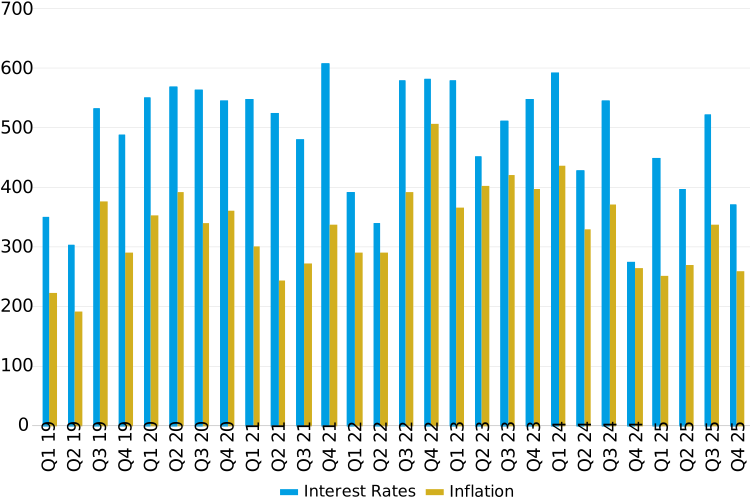
Total interest rate liability hedging activity decreased to £28.5 billion, whilst inflation hedging fell to £26.3 billion. LDI demand, long suppressed, did rebound to an extent in the final quarter of 2025, yet whilst participation rates were high in adjusting hedge ratios, volumes were low as pension funds are closer to their goals. The fall in activity is also somewhat a function of the decrease in issuance maturity as the net levels of interest rate risk supplied diminished. The DMO’s revolutionary approach to primary issuance, reducing and then removing scheduled long-end supply served to support the relative value of gilts vs swaps, prompting opportunities to take profits on gilts by switching into the equivalent swap.
The chart below describes hedging transactions as an index based on risk. Note that transactions include switches from one hedging instrument into another. It should be noted that as the index is constructed by using the rate of change of risk traded by each counterparty per quarter, it allows the introduction (or removal) of counterparties in the survey.
Chart 1: Index of UK pension liability hedging activity (based on £ per 0.01% change in interest rates or RPI inflation expectations i.e. in risk terms).
Source: Columbia Threadneedle Investments. As at 31 December 2025
The funding ratio index published by the Pension Protection Fund showed an increase in funding levels quarter-on-quarter (129.8% at end September vs 126.2% at end June). Higher real yields and global equity performance drove the positive outcome. The recent passing of the Pensions Schemes Bill has opened up new avenues for pension schemes as they weigh up run-on and surplus extraction versus buy-out pathways.
Market Outlook
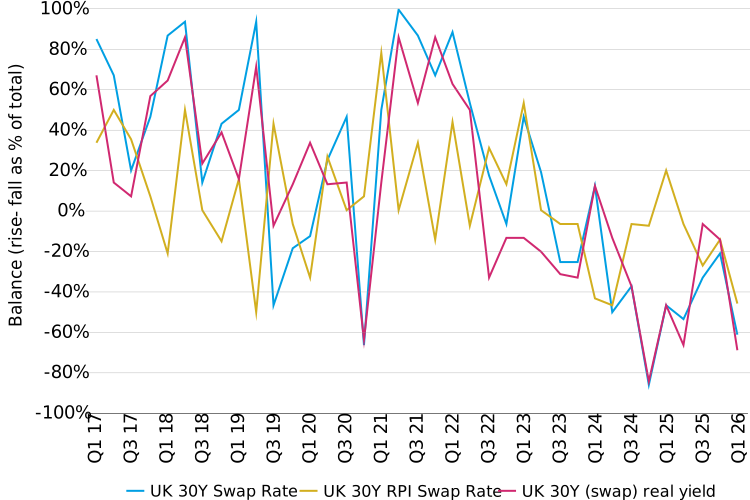
We also asked investment bank derivatives trading desks for their opinions on the likely direction of key rates for liability hedging. The aim is to get information from those closest to the market to aid investors in their decision-making.
The results are shown below as the number of those predicting a rise less those predicting a fall, as a percentage of the number of responses. The larger the balance, the more responses predict a rise. The more negative the balance, the more responses predict a fall.
Chart 2: Change in swap rates over the next quarter.
Source: Columbia Threadneedle Investments. As at 31 December 2025
Last quarter our counterparties expected a fall in all three metrics, albeit with limited conviction. In a relatively rare occurrence, they were correct! Interestingly, their views were more focused on fiscal consolidation in the Autumn Budget, which ultimately didn’t meet expectations, but the adjustments to issuance made by the DMO helped yields fall.
Looking forwards to the end of Q1 2026, there is a greater conviction in a continued fall in yields and long-dated inflation costs. Partly that reflects greater confidence in the supply dynamics, deferring the spectre of political risk until after quarter end with the May local elections. Notwithstanding the tilt in issuance towards shorter maturities, there is an additional tailwind of a lower cash requirement as the DMO are well ahead of their run rate allowing them to coast into fiscal year end. Indeed, the expected interest rate risk supply is on a level with August and December 2025, which are traditionally low supply months. There is also an optimistic view that the BoE may review its quantitative tightening envelope to reduce or end the active selling. Some of our counterparties refer to the announced consultation on increasing T-bill issuance – whilst an expansion is likely to be consensus this will not be realised in the short term.
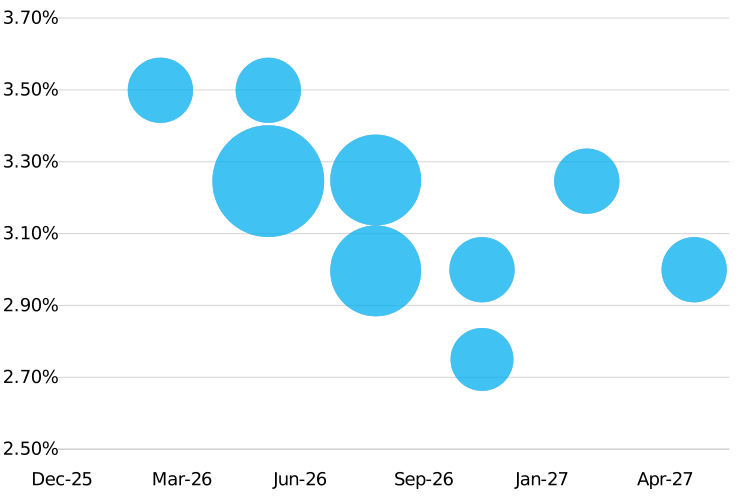
As we approach the end of the monetary easing cycle we asked our counterparties for their expectations of the terminal UK bank rate and when this would occur. There remains some variation between counterparty views, in both respects. Similarly to the previous quarter, there is consensus on at least one more cut from here with expectations for that cut ranging from March to July. As monetary policy approaches the end of its cycle it is common for decision makers to rely more heavily on data releases as it becomes fine-tuning. Inflation and wage expectations are key indicators for the Monetary Policy Committee (MPC).
Chart 3: Expectations of terminal Bank Rate
Source: Columbia Threadneedle Investments. As at 31 December 2025
At present the UK’s fiscal situation is considered to be relatively benign, yet that could be put at risk through political developments – notably a replacement for the Prime Minister, Keir Starmer, and/or the Chancellor, Rachel Reeves. Any movement on this front is more likely on the back of poor performance at the May local elections (or the upcoming by-election). There is a tendency for local elections to be challenging for the party in government, as lower turnout and ultimately fewer cares allow the public to express themselves via protest votes. This in on top of downward trailing polls of voting intentions which show Reform and the Conservatives above Labour at this moment. Recent revelations from the Epstein files have brought urgency to this topic. However, at the time of writing the majority of Cabinet members have come out to support Prime Minister Starmer. As to whether one or both of them will be replaced, our counterparties were split 50/50. The specifics of leadership challenge increase the complexity of a Prime Ministerial replacement, especially for Andy Burnham who would need to be a sitting MP. An alternative Chancellor would be an easier task, however, the impact of rumours of the Chancellor’s demise have been aired before and resulted in a market sell-off in the summer and thus a subsequent show of unity and support from the PM. Therefore, the most likely scenario would be a double replacement and according to Polymarket (a betting platform) the odds increase as the year progresses with a jump post the May local elections. In terms of the market impact, the likely short-term result would be higher yields as markets digest the possibilities of combinations of Prime Minister and Chancellor and their fiscal tendencies.
If you would like to learn more about any of the topics discussed, please contact your client director.
- Discover why UK yields may be set for another downward turn this quarter.
- Will political upheaval drive a surprise in the May local elections?
- Find out how DMO issuance and fiscal policy are shaping market forecasts.
- Is a double Cabinet replacement on the cards for 2026?
- Explore the data behind the Bank Rate expectations and inflation outlook.