

The GLP-1 market continues to expand rapidly yet remains in the early stages of growth. The GLP-1 market is no longer simply a weight-loss story. It is evolving into a broad cardiometabolic platform with expanding indications, improving formulations and a long runway for deeper penetration.
While the category has already reached significant scale, we believe investors may still be underestimating the durability of growth as innovation broadens use cases, improves adherence and expands access across patient segments.
What investors may still be underestimating
- Penetration remains low relative to the addressable population. The GLP-1 market has grown at over 40% annually and now exceeds $80 billion. Despite approximately 11 million US patients currently receiving treatment, significant runway for growth remains, as roughly 40% of the US population is overweight and may be eligible to benefit from GLP-1 therapy.
- Future growth may come from a broader range of patients, not just obesity patients. The clinical utility of GLP-1 therapies continues to expand beyond their primary uses in type 2 diabetes and obesity. Adoption is growing in areas such as obstructive sleep apnoea (OSA), where weight loss can significantly improve outcomes, while evidence of cardiovascular benefits has broadened their use among at-risk patients. The expanding range of indications may support continued growth in the addressable market over time.
- Oral therapies may expand the market, not simply replace injectables. New oral therapies are broadening adoption, with 8 out of 10 oral GLP-1 users new to the category.2
- Untapped global opportunity. Globally, the number of adults living with obesity is projected to rise from 810 million in 2020 to 1.53 billion by 2035, according to the World Obesity Foundation, underscoring the scale of unmet medical need and the potential long-term runway for effective treatments. While current therapies have delivered compelling outcomes, opportunities for further improvement remain, supporting continued innovation and long-term market expansion.
Collectively, these trends suggest the market’s opportunity extends well beyond weight loss alone. As new indications emerge, adoption broadens and more patients gain access to treatment, the number of patients receiving GLP-1 therapies continues to grow across both obesity and type 2 diabetes.
Market opportunity
The GLP-1 story is expanding beyond its diabetes foundation, with growing obesity use becoming a major driver of the industry’s long-term growth trajectory. This shift in utilisation helps explain why many investors view the category as a compelling multi-year growth opportunity.
The broadening use of GLP-1 therapies is evident in patient enrolment trends, which continue to reach new highs across key treatment categories.
GLP-1 patient adoption continues to climb
US patients on GLP-1 therapy (millions)
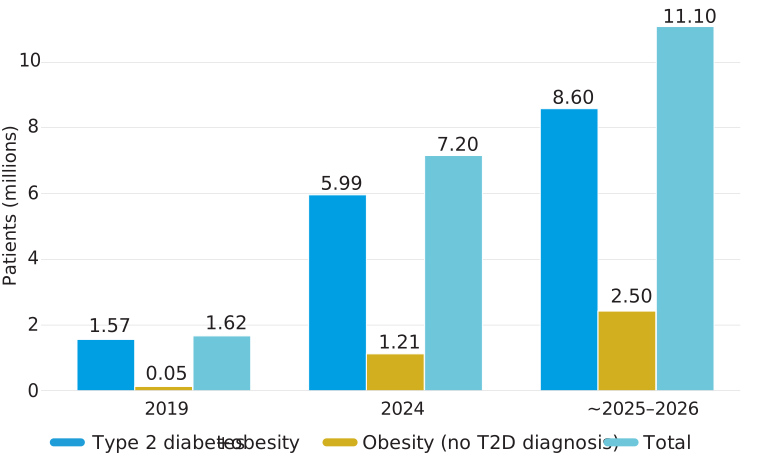
Source: FAIR Health, Inc. and Columbia Threadneedle Investments analysis. Data as of 31 July 2026.
Injectables lead, orals broaden adoption
Injectable GLP-1 therapies continue to dominate the market, supported by their superior efficacy and overall risk-benefit profile. Current injectable products generally deliver greater weight loss than oral alternatives, making them the preferred option for patients seeking substantial weight reduction.
Oral therapies, however, address an important unmet need. By eliminating injections, they offer greater convenience and may appeal to patients reluctant to self-administer injections. Orals may also be well suited to individuals seeking more modest weight loss or maintenance after achieving their target weight. Because oral therapies are relatively new, physicians and patients are still determining where they fit most effectively within the treatment landscape. Over time, oral GLP-1 therapies may support broader adoption and greater patient persistence, extending the runway for category growth.
The key question is not whether oral therapies will replace injectables, but how they will be positioned alongside them. We view oral GLP-1s as expanding the addressable market rather than materially cannibalising injectable demand.
Oral GLP-1s gain share in the obesity and total market
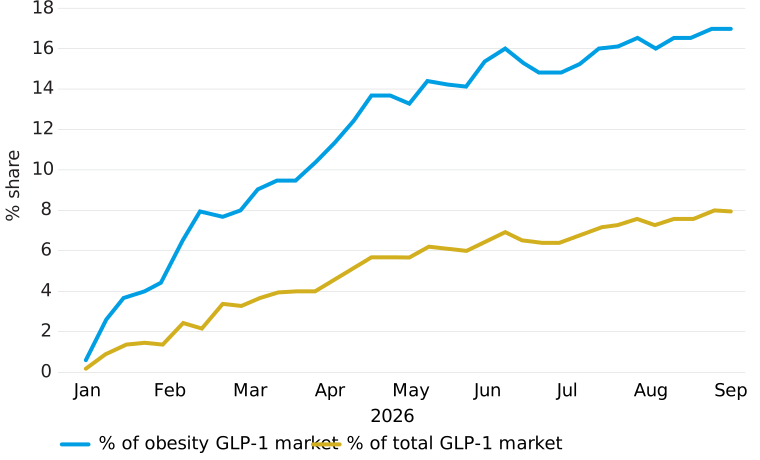
Source: Fierce Pharma; Columbia Threadneedle Investments analysis. Data as of 4 September 2026.
GLP-1s’ growth runway remains long
The GLP-1 market has emerged as one of largest pharmaceutical opportunities in history, driven by demand across type 2 diabetes, obesity and a growing list of related indications. Despite declining prices, industry revenues continue to grow at a rapid pace as patient adoption rises. Yet penetration remains remarkably low compared to the potential addressable market. Despite rapid growth, GLP-1 therapies remain relatively underpenetrated in the US, while adoption rates in international markets are even lower. While the market has experienced high double-digit annual growth in recent years, consensus forecasts anticipate growth moderating to approximately 14% annually over the next five years. We believe those expectations may prove conservative. Given the pipeline of improved drugs on the horizon, continued innovation, broader clinical applications and deeper market penetration could support faster growth than is currently reflected in market estimates. The table below highlights the extent of the opportunity, comparing current penetration levels with the market’s substantial remaining growth potential.
GLP-1 market consensus estimates point to continued expansion
2026 | 2027 | 2028 | 2029 | 2030 | 2031 | ||
|---|---|---|---|---|---|---|---|
Total GLP-1 class | 98.6 | 120.7 | 138.4 | 158.9 | 174.2 | 190.6 | |
22.5% | 14.6% | 14.8% | 9.7% | 9.4% | |||
Source: Bloomberg L.P., Columbia Threadneedle Investments analysis. Data as of 4 September 2026.
Execution and innovation are shaping competitive leadership
Competitive advantage in GLP-1s is increasingly being defined by more than first-mover status. Scale, manufacturing reliability, breadth of indications, clinical differentiation, payer access, pricing strategy and pipeline depth are all becoming critical determinants of long-term share. The market share impact of these competitive dynamics is already evident. As shown below, Lilly has steadily gained share at the expense of its closest competitor.
Lilly currently holds approximately 62% of the GLP-1 market, compared with roughly 38% for Novo Nordisk, and recent competitive trends suggest the company is well positioned to maintain, and potentially extend, its leadership position. Lilly’s portfolio, anchored by Mounjaro and Zepbound, has benefited from strong clinical efficacy, broad demand and improved product availability. Looking ahead, the company is expected to seek regulatory approval for retatrutide, a next-generation GIP/GLP-1/glucagon therapy, in 2027. While numerous competitors are advancing obesity and metabolic disease treatments, Lilly’s pipeline remains among the deepest in the industry, supported by decades of investment and expertise in this therapeutic area.
Lilly extends its lead in the GLP-1 market
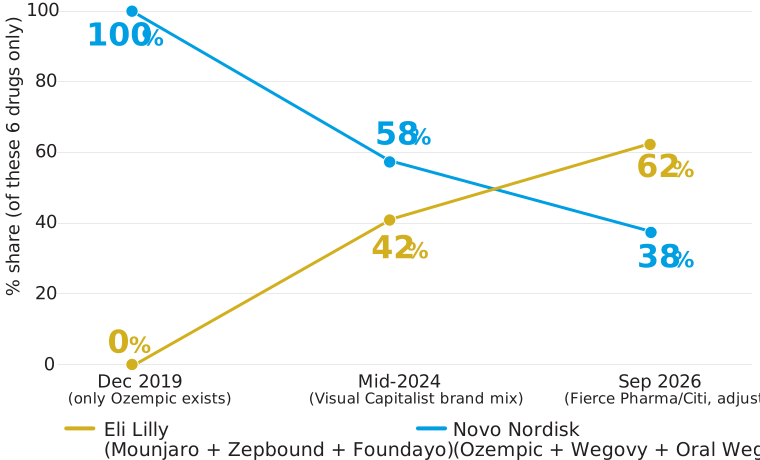
Source: Flagship drug market includes Mounjaro, Zepbound, Foundayo, Ozempic, Wegovy and Oral Wegovy. Fierce Pharma; Columbia Threadneedle Investments analysis. Data as of 17 July 2026.
Lilly has established a leadership position through strong commercial execution and a growing portfolio of therapies, including Mounjaro, Zepbound and recently approved next-generation products (Foundayo). While Novo Nordisk pioneered the category with Ozempic and Wegovy, Lilly has gained share by demonstrating a better risk/benefit profile, expanding manufacturing capacity, improving product availability and advancing a broad clinical development programme.
Compounded GLP-1 therapies gained traction during branded-drug shortages by offering greater availability and lower prices. An estimated one million patients remain on compounded products, which typically cost $150 to $285 per month. However, as branded supply has improved and manufacturers have lowered prices, the gap in cost and availability has narrowed, reducing the relative appeal of compounded alternatives.
The table below compares the current pricing and access landscape across leading obesity and diabetes therapies.
Comparative pricing across market leaders
Primary usage | Company | Product | WAC price(Wholesale acquisition cost, per month) | Lowest direct-to-consumer price (per month) |
|---|---|---|---|---|
Oral obesity | Lilly Novo Nordisk | Foundayo Wegovy pill | $649 $1,349 | $149 (0.8 mg) $149 (1.5 mg) |
Injectable obesity | Lilly Novo Nordisk | Zepbound Wegovy pen | $1,086 $1,349 | $299 (2.5 mg) $199 (0.25, 0.5 mg*) |
Type 2 diabetes | Lilly Novo Nordisk | Mounjaro Ozempic | $1,077 $1,028 | $499 (2.5–15 mg) $149 (0.25, 0.5 mg**) |
* First 2 months for new patients; then rises to $299/month.
**First 2 months for new patients; then rises to $349/month.
Source: Company reports and Columbia Threadneedle Investments analysis. Data as of 31 July 2026.
Pipeline innovation points to a longer growth runway
Current GLP-1 drugs have delivered impressive clinical and commercial success, but meaningful opportunities for improvement remain. The next generation of therapies are focused on improving tolerability, preserving lean muscle mass, increasing weight-loss efficacy, reducing dosing frequency and expanding oral treatment options. While recent advances have been remarkable, they are the product of decades of research and innovation.
The first GLP-1 therapy, Lilly’s exenatide, was introduced in 2005 and required twice-daily dosing while offering modest weight-loss benefits and limited tolerability. Today’s products represent a significant step forward, and we expect ongoing innovation to further improve efficacy, convenience and patient outcomes.
Several late-stage candidates warrant close attention, including Lilly’s eloralintide, long-acting tirzepatide and retatrutide, Novo’s CagriSema, Amgen’s MariTide and Kailera’s oral ribupatide. These programmes could improve efficacy, convenience and tolerability, further expanding the addressable market.
Risks to monitor
The category’s growth trajectory is not without risk. Greater competition could intensify pricing pressure, while reimbursement changes may affect patient access and affordability. Adoption in new indications could also develop more slowly than expected, and next-generation therapies may alter the competitive landscape. Regulatory setbacks, manufacturing constraints and product-supply disruptions remain additional risks for companies operating in the market.
The bottom line
Despite remarkable growth, the GLP-1 opportunity remains far from fully realised. Low market penetration, expanding clinical applications and continued innovation could support category growth for years to come. As innovation continues and adoption broadens, GLP-1s have the potential to deliver better patient outcomes while creating durable opportunities for well-positioned companies.